Economy · 25 September 2026 · 9 min read
Ghana earns more from the rest of the world than at any time in its history. In 2025 the trade surplus nearly tripled, reserves climbed to its highest level in years, inflation fell to single digits
Why Ghana's record export boom of 2024–2025 has not become a jobs boom, and what it will take to turn one into the other
By Dr. Edwin Provencal
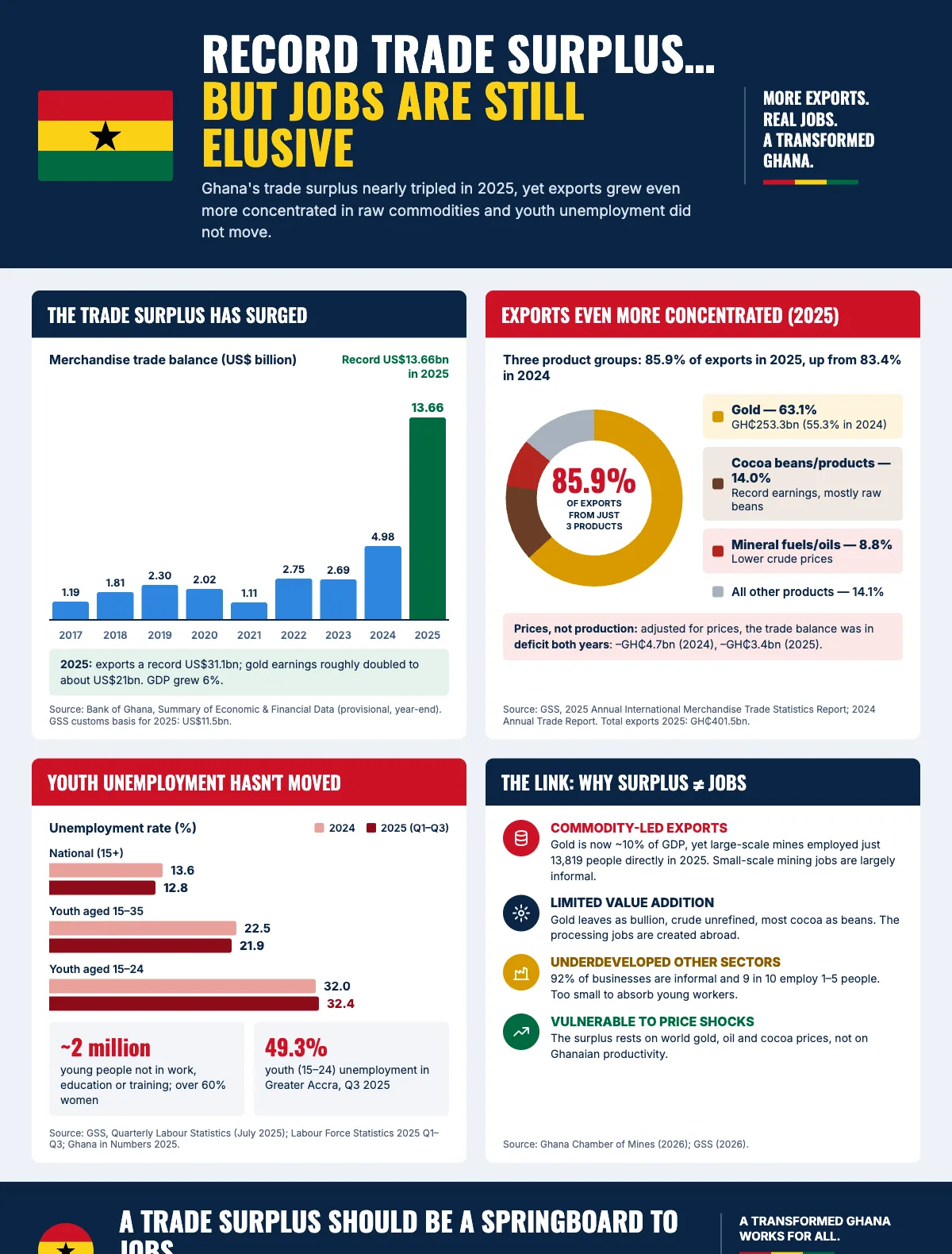
Ghana is earning more from the rest of the world than at any time in its history. In 2025 the trade surplus nearly tripled, reserves climbed to their highest level in years, inflation fell to single digits and the economy grew by 6 per cent. On paper, the external accounts have never looked healthier.
Yet walk through Kaneshie, Kasoa or Kumasi and ask a 22‑year‑old graduate what has changed, and the answer is likely to be: very little. Nearly one in three young Ghanaians aged 15 to 24 who want work cannot find it, and close to two million young people are neither working, studying nor training. The puzzle at the heart of our economy is simple to state: how can a country run a record trade surplus while its young people still cannot find jobs?
The answer lies not in how much we export, but in what we export and how we export it. Two years of data, 2024 and 2025, make that answer clearer than ever.
At a glance: 2024 versus 2025
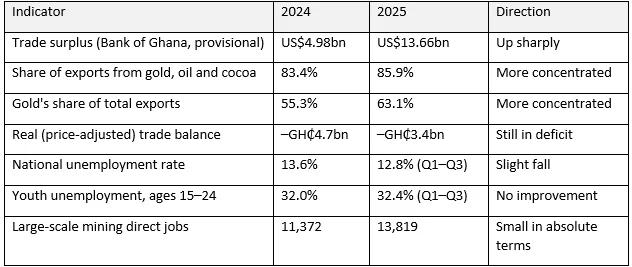
Sources: Bank of Ghana; Ghana Statistical Service; Ghana Chamber of Mines (see Sources).
The good news: the surplus has grown, then surged
Ghana's merchandise trade balance has been in surplus every year since 2017, but the last two years mark a step change. In 2024 the Bank of Ghana recorded a provisional surplus of US$4.98 billion, nearly double the US$2.69 billion of 2023 and equal to 5.9 per cent of GDP, driven by a 53 per cent rise in gold exports to US$11.6 billion (Bank of Ghana, 2025).
2025 went much further. Export receipts reached a record US$31.1 billion, gold earnings roughly doubled to about US$21 billion, and the trade surplus rose to a provisional US$13.66 billion (Bank of Ghana, 2026). The Ghana Statistical Service, which measures trade from customs records, puts the 2025 surplus at GH₵148.3 billion (about US$11.5 billion), more than three times the 2024 figure, with exports exceeding imports in every month of the year (GSS, 2026a).
The wider economy benefited. GDP grew by 6 per cent in 2025, the fastest since 2019; inflation fell from 23.8 per cent in December 2024 to 5.4 per cent a year later; and gross reserves reached US$13.8 billion, or 5.7 months of import cover (GSS, 2026b; GSS, 2026d).
This matters. A strong surplus steadies the cedi, rebuilds reserves, eases prices and gives government room to plan. It is an achievement worth protecting. But it is not, by itself, a jobs strategy.
The concern: our exports rest on three commodities, and increasingly on one
In 2024 gold, mineral fuels and oils, and cocoa accounted for 83.4 per cent of Ghana's exports, with gold alone at 55.3 per cent (GSS, 2025a). In 2025 the concentration deepened further:
- Gold: GH₵253.3 billion, 63.1 per cent of all exports
- Cocoa beans and products: 14.0 per cent
- Mineral fuels and oils: 8.8 per cent
- Together: 85.9 per cent of total exports (GSS, 2026a)
Gold export earnings in 2025 exceeded those of cocoa and crude oil combined, and gold became the largest single sub‑sector of the economy at nearly 10 per cent of GDP (Ghana Chamber of Mines, 2026). The Government Statistician summed up the risk plainly when presenting the GSS's two‑decade trade review: gold is our anchor, but it is also our greatest exposure (GSS, 2026c).
The warning sign: prices, not production
The surplus has been driven largely by higher world prices rather than higher volumes. Adjusting for price changes, Ghana's trade balance was actually in deficit in both years: a real deficit of GH₵4.7 billion in 2024 (GSS, 2025b) and of GH₵3.4 billion in 2025, even as the nominal surplus reached GH₵148.3 billion (GSS, 2026a).
In other words, the world paid us far more for broadly the same basket of raw materials. That is good fortune, not transformation, and good fortune can reverse with the next turn in the gold, oil or cocoa markets.
The reality: the jobs picture has barely moved
While export earnings soared, the labour market improved only at the margins:
- National unemployment averaged 13.6 per cent in 2024 (down from 14.6 per cent in 2023) and 12.8 per cent in the first three quarters of 2025, edging back up to 13.0 per cent in the third quarter (GSS, 2025c; GSS, 2025d).
- Youth unemployment did not improve at all. Among 15–24‑year‑olds it averaged 32.0 per cent in 2024 and 32.4 per cent in the first three quarters of 2025; among 15–35‑year‑olds, 22.5 per cent and 21.9 per cent.
- In Greater Accra, unemployment among 15–24‑year‑olds reached 49.3 per cent in the third quarter of 2025: nearly one in every two young people in the capital who wanted work could not find it.
- Close to two million young people are not in employment, education or training, and more than 60 per cent of them are women (GSS, 2026d).
- Seven in ten unemployed Ghanaians are young people.
The quality of work is as much a concern as its quantity. Labour force participation rose from 67.1 per cent in 2022 to 74.5 per cent in 2025, but 92 per cent of businesses operate informally and nine in ten establishments employ between one and five people; only 4,874 establishments employ 100 or more (GSS, 2026d). The Statistical Service's own verdict is that the growing economy is not yet creating enough decent jobs.
The trade line has gone up steeply. The jobs line has barely moved. The gap between them is the central economic challenge of our generation.
The link: why a surplus does not equal jobs
Commodity‑led exports create few direct jobs. Gold, oil and cocoa beans are earned through capital‑intensive extraction or primary production. In 2025 gold earned around US$20 billion in exports and contributed nearly 10 per cent of GDP, yet the producing members of the Ghana Chamber of Mines employed just 13,819 people directly, up from 11,372 in 2024 (Ghana Chamber of Mines, 2025; 2026). That is a valuable contribution to formal employment and tax revenue, but it is a drop in a labour force of more than 14 million.
Much of the growth in gold output has come from small‑scale mining, which rose by about 64 per cent in 2025 and now supplies more than half of national production (Ghana Chamber of Mines, 2026). Small‑scale mining does employ many people, but largely in informal, insecure and often hazardous work, and illegal mining continues to damage water bodies and cocoa farms. It is not the decent, productive employment a transforming economy needs.
We export raw materials and import the jobs.
Most of what we sell still leaves Ghana raw or barely processed: gold as bullion, crude oil unrefined and much of our cocoa as beans. The jobs in refining, manufacturing, branding, packaging and logistics, where most of the value and most of the employment lie, are created in the countries that buy our raw materials. There are encouraging signs: cocoa products now make up a growing share of non-traditional exports (GSS, 2026c). But every tonne of cocoa beans exported unprocessed is still, in effect, an export of Ghanaian jobs.
Other sectors remain underdeveloped
The sectors that could absorb large numbers of workers – manufacturing, agro-processing and modern services – remain too small, too informal and too weakly linked to the commodity economy. A business landscape dominated by micro-enterprises cannot absorb the hundreds of thousands of young people who enter the labour market every year.
We are exposed to price shocks
Because the surplus rests on world prices, it can disappear as quickly as it arrived. The fact that the real trade balance stayed in deficit through two record years shows how much of our current strength is borrowed from the market. An economy that cannot control the price of what it sells cannot plan its jobs around it.
6. The way forward: from surplus to jobs
The 2024–2025 windfall is an opportunity, and Ghana should use it deliberately. Four priorities stand out.
- Add value locally. Refine and fabricate more of our gold at home, process a far larger share of our cocoa into paste, butter and finished products, and build the downstream petroleum and petrochemical industries that turn crude into jobs. Value addition is where employment multiplies.
- Diversify exports. Grow manufacturing, agribusiness and tradable services, and use the African Continental Free Trade Area, whose secretariat is in Accra, to sell Ghanaian goods to a market of more than a billion people. Support SMEs to formalize, grow and reach export markets.
- Invest in people. Close the gap between what our schools teach and what employers need, with practical skills, technical and vocational training, STEM education and support for young entrepreneurs, with a particular focus on the young women who make up most of those not in work or training.
- Create quality jobs. Measure success not only by the trade balance but by the number of decent, formal and productive jobs created. Channel a share of commodity windfalls into infrastructure, affordable credit for private enterprise and programmes that crowd in investment in labour-intensive sectors.
Conclusion: a springboard, not a comfort
Ghana's trade surplus is real and worth celebrating. But two record years have shown that it reflects high prices for a narrowing basket of raw commodities more than a transformed economy. Exports nearly tripled their surplus between 2024 and 2025; youth unemployment did not move.
The task now is to convert external strength into domestic opportunity: to process what we produce, diversify what we sell, and prepare our young people for the jobs that follow. A trade surplus should be a springboard to jobs, not a comfort for complacency.
More exports. Real jobs. A transformed Ghana that works for all.
Sources
- Bank of Ghana (2025) Summary of Economic and Financial Data, January 2025: provisional 2024 trade balance.
- Bank of Ghana (2026) Summary of Economic and Financial Data, January 2026, and Monetary Policy Report: provisional 2025 trade balance and export receipts.
- Ghana Chamber of Mines (2025) Publish What You Pay Report 2024. Accra: Ghana Chamber of Mines.
- Ghana Chamber of Mines (2026) Address to the 98th Annual General Meeting: 2025 gold production, employment and contribution to GDP.
- GSS (2025a) 2024 Annual Trade Report. Accra: Ghana Statistical Service.
- GSS (2025b) 2024 Annual Trade Report: real trade balance.
- GSS (2025c) Quarterly Labour Statistics, July 2025 Edition. Accra: Ghana Statistical Service.
- GSS (2025d) Labour Force Statistics 2025, Quarters 1–3, released 18 December 2025. Accra: Ghana Statistical Service.
- GSS (2026a) 2025 Annual International Merchandise Trade Statistics Report. Accra: Ghana Statistical Service.
- GSS (2026b) Provisional annual GDP estimates for 2025, released 17 March 2026. Accra: Ghana Statistical Service.
- GSS (2026c) Ghana's Merchandise Trade Statistics, 2004–2025: Two Decades in Review. Accra: Ghana Statistical Service.
- GSS (2026d) Release on the economy, businesses and the labour market, October 2026; and Ghana in Numbers 2025. Accra: Ghana Statistical Service.